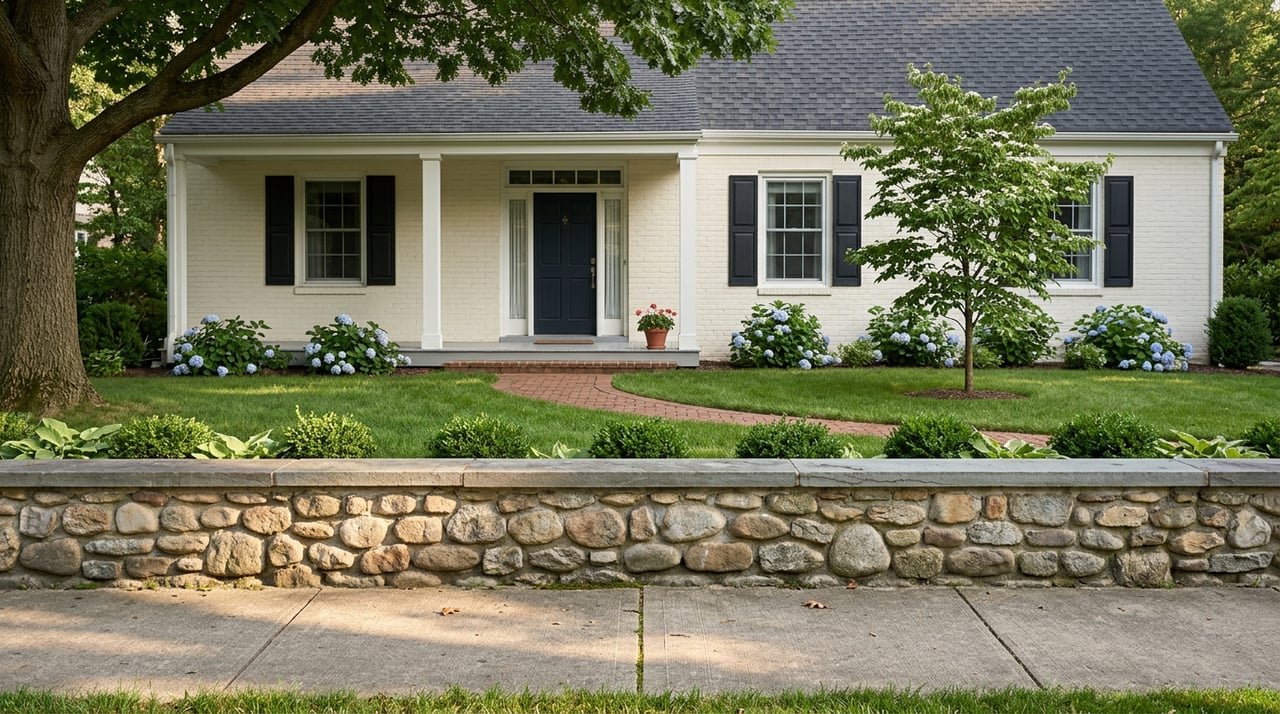
By late June the shade on Russell Road has closed in overhead, and the sidewalk between Braddock and Cameron Mills reads more like a country lane than a route into the city. Someone is walking a dog past the low stone wall at Mount Ida. Two kids on scooters cut across Mansion Drive toward the Alexandria Country Day School lot. A Fresh Market bag swings from a neighbor's hand as she waits for the light at King. It is the summer version of a scene Jefferson Park runs on repeat, and if you live inside its four boundary streets, you already know how the day is going to unspool.
Here is the argument for why that predictability is a feature, not a rut. Jefferson Park is small enough that the same short loop, the same shopping center, and the same annual picnic keep bringing the same neighbors into contact. In a city of 160,000 people, that scale is unusual. The neighborhood behaves like a small town wedged into the middle of one.
The loop everyone walks
Jefferson Park sits inside four streets: Mansion Drive, Cameron Mills, Braddock and Russell Roads. That footprint holds roughly two hundred houses, which is small enough that a thirty-minute walk covers most of them. The interior streets curl rather than grid, so a route out from Mansion Drive rarely looks the same twice even when the mileage is identical.
Two things make the summer version of this walk hold up against the July humidity. The first is the tree canopy. North Ridge and its enclaves, Jefferson Park included, took shape mostly between the 1930s and early 1960s, and the willow oaks, red oaks and tulip poplars planted by the first wave of owners are now full grown. The area is residential with homes of numerous styles, mostly single family two-story and basement houses largely developed in the period of the 1930s through the early 1960s, and the trees came up with them. The second is the architectural variety. A block that opens with brick Colonials will pivot into a Cape, then a Spanish-style ranch, then a custom stone house on Mansion Drive that would look at home outside Middleburg. Nothing repeats. That is the walkable payoff of a neighborhood that infilled slowly rather than getting stamped out at once.
If the loop has a psychological center, it is Mount Ida. The house sits behind an old stone wall on Russell Road and reads as a Southern plantation dropped into a Northern Virginia subdivision, which is more or less what happened.
The house that gave the neighborhood its name
Mount Ida is the reason Jefferson Park is a proper name and not a real estate marketing coinage. According to the North Ridge Citizens' Association history published in a 2003 Washington Post feature on the neighborhood, Mount Ida mansion was built in the early 1800s by Charles Alexander Jr., a descendant of John Alexander, for whom Alexandria was named. The story residents still repeat about the Civil War years is that the white, high-columned mansion off Russell Road enjoyed federal protection during the Civil War because its then-owner, John Lloyd, was a friend of Abraham Lincoln.
The interesting arc is what came next. In 1942, Mount Ida was bought by the Sisters of the Holy Cross and converted to a convent. St. Mary's Academy was built on the property. In the early 1990s, Alexandria Country Day School bought the academy, and the mansion was sold to a developer. After much community input, originally 21 townhouses were proposed and opposed, nine Georgian-style houses were built around the mansion. That negotiation, twenty one townhouses shrunk to nine detached Georgians, is why the walk past Mount Ida still feels like walking past a country estate and not a condo pod. It is also why the neighborhood has an unusually strong collective memory of what showing up to a planning meeting can accomplish.
Two schools sit inside the loop. Alexandria Country Day occupies the Mount Ida grounds. The Lower School of private St. Stephen's & St. Agnes School is located in the Jefferson Park neighborhood of North Ridge. Between drop-off, pick-up, and weekend soccer, they double as the neighborhood's informal town square on weekdays.
The Bradlee run
The other town square is a shopping center. Bradlee sits at the west edge of Jefferson Park where King Street meets Quaker Lane, close enough that most residents fold it into a walk or a five-minute drive without thinking about it. It is a workhorse, not a destination, which is exactly what a close-in neighborhood wants from the retail parcel next door.
The current tenant mix at Bradlee Shopping Center includes Bank of America, Beeliner Diner, BonChon, Bradlee Barber Shop, Cava, Chipotle, CityVet, Crumbl Cookies, Duck Donuts, Hallmark, Kyoto Sushi, McDonald's, MedStar Health Urgent Care, Michaels, Orangetheory Fitness, Spicelife Indian Fare, Starbucks, StretchLab, The Fresh Market, The Joint Chiropractic, Tropical Smoothie Cafe, Truist, a US Post Office and a Virginia ABC store. That list explains a lot of the summer's small logistics. The Fresh Market anchors weekend cooking. The post office at Bradlee is the highest volume post office in Alexandria, which is worth knowing when you time a package drop. CityVet keeps the neighborhood's substantial dog population in shots.
The context matters too. Bradlee is a grocery anchored center on King Street that, according to its landlord First Washington, consistently sees more visitors than any other shopping center within a five-mile radius, a testament to its strong tenant mix and lasting neighborhood presence. Translation: on a Saturday morning, everyone you know is already there.
The picnic on the calendar
If Bradlee is where the neighborhood accidentally runs into itself all summer, Labor Day is where it does so on purpose. Jefferson Park's front-yard potluck picnic is the fixed point the rest of the season leans toward.
The tradition was documented in the same 2003 Post feature that ran the Mount Ida history. The Labor Day potluck picnic has been held for decades in the front yard of Gallaudet University professor Carol LaSasso and her husband, Jim. That event, which began with 75 neighbors, has grown to about 600. The mechanics are pure small-town logistics. Neighborhood children hand-deliver the invitations to all the neighbors. One neighbor, a retired colonel, buys 250 Baskin-Robbins ice cream sandwiches for all the kids. A house count of roughly two hundred and an attendance count of six hundred means the picnic pulls in more than three residents per household. That is not a block party. That is the whole neighborhood, plus extended family, plus alumni who moved out and drove back in.
Two smaller traditions sit alongside it. Jefferson Park residents often gather for potluck meals and more, such as the annual Labor Day picnic and even a dog talent show. The dog talent show is exactly what it sounds like and gives some structure to the mid-summer stretch before Labor Day pulls everyone together.
The lore that residents tell about themselves is worth taking seriously here. A longtime resident quoted in the Post piece drew a contrast between neighborhoods where people leave the neighborhood and you don't see them much, the 'garage people' who lift up the garage door and leave, and Jefferson Park, where everyone is out and about within the neighborhood, older families and younger ones, walking dogs, and groups of teenagers who will stop and talk to you. That description held in 2003. The house count has not changed materially since. The Labor Day headcount suggests it still holds.
What a summer weekend actually looks like here
For someone who already lives in Jefferson Park, the July into September stretch has a rhythm that runs on the assets above rather than on anything you would fly a flag about:
- A morning walk that loops Mansion Drive, cuts past Mount Ida on Russell, and comes back along Cameron Mills, roughly a mile and change under near-continuous canopy.
- A Bradlee run that manages groceries at The Fresh Market, coffee at Starbucks or a pastry from the Alexandria Pastry Shop, and a post office errand in one stop.
- A midday retreat to the shade because the block does not fully cool until the sun clears the tree line around six.
- An evening on the porch, which in Jefferson Park is often a screened one attached to a 1930s Colonial rather than a deck out back.
- A Metro commute worth noting only because the neighborhood is quiet enough that residents forget how close it is. The Braddock Road station is about a mile and a half from most of the loop, walkable in weather, an easy bike in the rest of the year.
- A Labor Day calendar block that starts arriving in mailboxes, hand delivered, sometime in mid-August.
None of that is exotic. The point is that it is repeatable, close in, and shared. A neighborhood of two hundred houses is small enough that the same short list of activities produces genuine familiarity rather than the friendly-stranger version most close-in DC-area neighborhoods settle for. The trees, the mansion, the shopping center and the picnic are the reason.
If you have lived here for a while, none of this is news. It might be worth writing down anyway, because summer is when the pieces that make Jefferson Park work are most visible, and it is easy to take them for granted the rest of the year.
If you are thinking about what your Jefferson Park home is worth heading into the fall market, or you want a quiet conversation about timing, Your Alexandria Home is glad to help. Get your free Alexandria home valuation and we will pair the number with the neighborhood context that makes it useful.