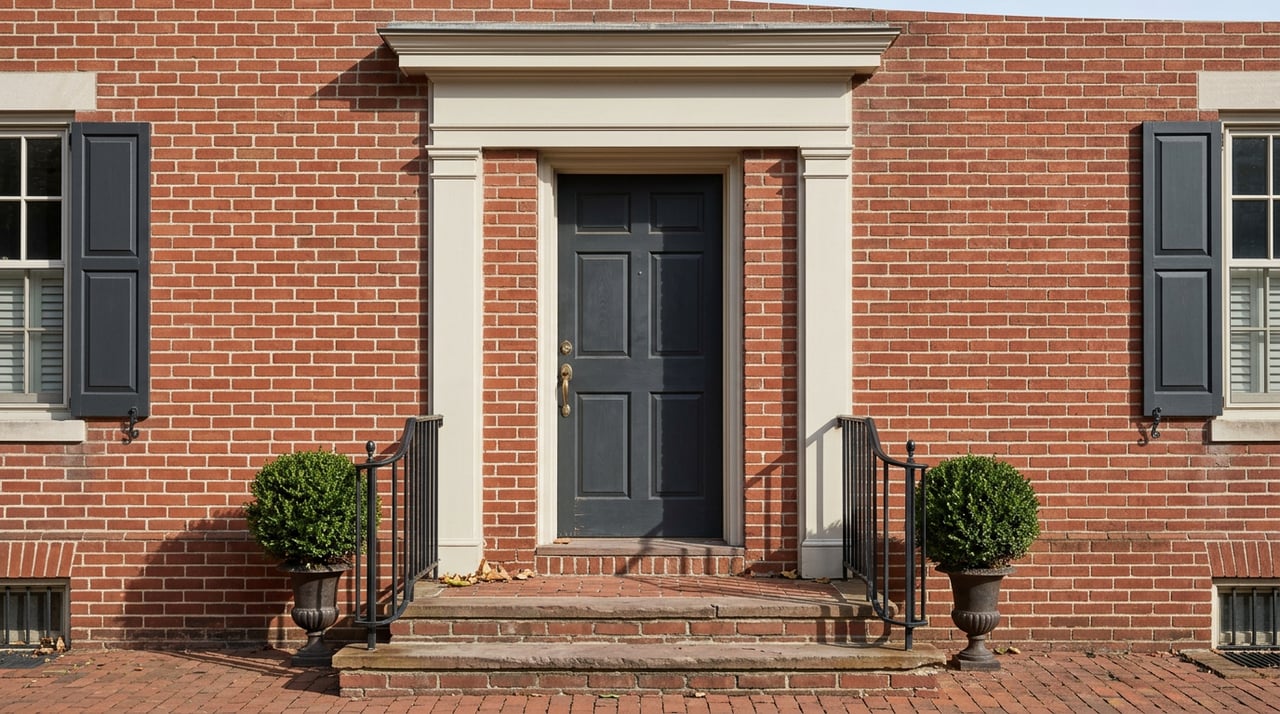
For most of the summer, Alexandria's rewrite of the rules that govern exterior work in Old Town looked like it was moving in a straight line. The Zebra reported that draft chapters went up in early August. One public meeting followed. A comment period ran alongside it. Adoption hearings were supposed to come next, sometime in the fall. On September 2, that comment period closed. If you were tracking the calendar the way a homeowner planning a renovation would, the next milestone should have been the Board of Architectural Review's October hearing.
Instead, the city added another public meeting. It's scheduled for September 23, three weeks past the date most people assumed was the last stop before adoption.
That gap is not just a scheduling footnote. If you own a rowhouse in the Old and Historic Alexandria District, or in Parker-Gray, or you're weighing an offer on one that needs work, the guidelines your project will be measured against are not settled right now. They're being negotiated chapter by chapter, in public, while permit applications keep moving through the pipeline underneath them. And the board that eventually rules on your Certificate of Appropriateness has already said, in its own public meeting, that its standards are qualitative rather than fixed. A moving document combined with a discretionary reading of it is the real friction point for anyone with exterior work planned in Old Town this fall, whether that's a homeowner, a buyer eyeing renovation potential, or a seller weighing pre-listing improvements.
What Actually Triggers a BAR Review
Not every project in Old Town needs a hearing, and not every change needs approval at all. The City of Alexandria says interior work is exempt outright. The Board of Architectural Review only has authority over exterior architectural features visible from a public street or alley, plus any proposed demolition or encapsulation of more than 25 square feet of material on a structure, regardless of whether it's visible from the street. The board itself is a seven-member panel appointed by City Council, made up of two architects, one property owner from the Old and Historic Alexandria District, one from Parker-Gray, and three citizen members. It meets on the first and third Wednesday of every month except August.
Within that authority, there are two very different tracks, and knowing which one your project falls into changes your timeline by weeks or months.
| Review Track | Typical Projects | Who Approves It | Typical Timeline |
|---|---|---|---|
| Administrative | Repainting in the same color, in-kind roof repair, compliant signage, minor landscaping, routine maintenance | Preservation staff | Days to a couple of weeks |
| Full BAR Hearing | Additions, new construction, demolition of more than 25 square feet, major facade or window changes | The seven-member Board of Architectural Review, at a public hearing | Tied to the board's twice-monthly meeting calendar, often adding several weeks once submission deadlines are factored in |
The administrative track exists precisely because not every change needs a public hearing. But the line between "minor alteration" and "significant exterior alteration" is a judgment call, and that judgment is exactly what's being rewritten right now.
"Guidelines," Not Code
Zoning setbacks are numbers. You either meet them or you don't. Old Town's design guidelines don't work that way, and the city said so plainly at its August 19 public meeting on the rewrite.
When residents at that meeting asked which of the proposed recommendations would actually be enforceable, city planners explained that the guidelines provide qualitative standards the board uses when it considers a Certificate of Appropriateness, not a checklist with pass or fail thresholds. Failing to meet a guideline can still give the BAR grounds to deny an application, even without a specific numeric violation to point to. That's a meaningfully different system from a building code. It means two nearly identical requests, a rear deck, a window swap, an HVAC relocation, can land on different sides of an approval depending on how the board reads the same guideline language on a given Wednesday.
That's not a criticism of the board. It's the reason the guidelines are being rewritten in the first place: to sharpen language that's been read inconsistently. But it also means that anyone treating the current draft chapters as a preview of settled rules is reading a document that's still moving.
The Rewrite in Motion
Here's where the timeline actually sits. Draft chapters covering both the Old and Historic Alexandria District and the Parker-Gray Historic District went up for public review starting August 5. Eleven chapters are in play. On August 19, Alexandria's Historic Preservation Division held a public meeting at the Nannie J. Lee Memorial Recreation Center, led by planner Brendan Harris, with principal planner Julie Weisgerber and preservation architect Bill Conkey also presenting.
The categories under revision are the ones that come up constantly in renovation conversations right now: electric vehicle chargers, HVAC equipment placement, exterior lighting, security features, porches, decks, roof decks, and balconies. The draft also aims to clean up terminology that's caused confusion in past reviews, distinguishing more clearly between street-facing and non-street-facing elevations, and it proposes classifying buildings by construction age, "Early" for anything built before 1932 and "Later" for anything built after 1931, with the level of review varying accordingly. That age split already exists in Parker-Gray. Part of the goal is to bring Parker-Gray's standards closer to what's already used in Old Town proper.
Public comment on those eleven chapters ran through September 2. Under the timeline the city laid out in August, the next step was supposed to be formal adoption hearings before the full board sometime in October. Instead, on September 6, the city announced a new public meeting for September 23, three weeks after the comment window had already closed and still weeks ahead of the original October target.
That's the tell. A comment period that closes cleanly and gets followed by a straight path to adoption is a sign the draft has converged. A comment period that closes and then gets a new meeting anyway is a sign it hasn't, at least not yet. Nobody outside city staff knows today whether October adoption still holds, and treating it as a fixed date right now is a guess dressed up as a schedule.
What This Means If You Have a Project or a Listing on the Calendar
That matters most for the categories the rewrite actually touches. If you're planning a rooftop deck, relocating an HVAC condenser, adding EV charging, or replacing exterior lighting or security fixtures, you're proposing work in exactly the chapters currently being renegotiated. A contractor's estimate of "a few weeks to approval" based on last year's guidelines may not hold if your hearing date falls on the other side of adoption.
This isn't just a scheduling inconvenience. Renovation completeness is one of the biggest price differentiators from one Old Town block to the next. Two similar rowhouses on the same street can carry very different values depending on how much of the exterior work is already done and done well. Getting the sequencing wrong, starting a project on one set of assumptions and finishing it under another, can cost real time and real dollars on exactly the kind of improvement that's supposed to add value before a sale.
A few things worth doing before you finalize anything:
- Call Alexandria Preservation staff before you lock in a design, and ask directly whether your specific project falls under a chapter currently in the rewrite. Staff can tell you if your timeline realistically clears before or after adoption hearings.
- If you already have an application in the pipeline, ask where it sits relative to the board's meeting calendar. The board meets the first and third Wednesday of the month, except August, and a hearing date on either side of an adoption vote can mean a different set of standards applied to the same request.
- If you're prepping a listing that depends on exterior work, build BAR review time into your own calendar rather than your contractor's best-case estimate, with extra margin for anything touching EV charging, HVAC, decks, or lighting.
- If you're buying a property with renovation plans in mind, don't take "it just needs a Certificate of Appropriateness" as the full answer. Ask whether the specific work falls into one of the eleven chapters currently open for revision.
Frequently Asked Questions
My home isn't in Old Town's historic core. Does any of this apply to me? The rewrite covers the Old and Historic Alexandria District and the Parker-Gray Historic District, along with individual structures citywide on the 100-Year-Old Buildings list.
What kind of work is most likely to be caught up in the current rewrite? The draft chapters focus specifically on electric vehicle chargers, HVAC equipment, exterior lighting, security features, porches, decks, roof decks, and balconies, along with a reworked building-age classification. If your project touches any of those categories, it's worth a direct conversation with preservation staff before you finalize a design, not after.
Where This Leaves You
None of this means BAR review is something to avoid or dread. It exists because Old Town's streetscape is worth protecting, and most homeowners here appreciate that as much as anyone. What it does mean is that the usual advice, get your Certificate of Appropriateness early and budget a few extra weeks, isn't quite specific enough this fall. The document your project will be measured against is mid-revision, the board reads it qualitatively rather than as a checklist, and the timeline the city laid out in August has already grown a step nobody expected in early September.
If you're weighing a renovation before a sale, evaluating a historic property with work in mind, or just trying to figure out how a project you already started fits into a process that's shifting under it, Adrianna Vallario can walk through the specifics with you and connect you with the right people at the city before you spend money on a design that might need to change twice. Get your free Alexandria home valuation and let's talk through the timeline that actually applies to your address.
This article is general information, not legal, tax or financial advice. Consult a qualified professional about your situation.