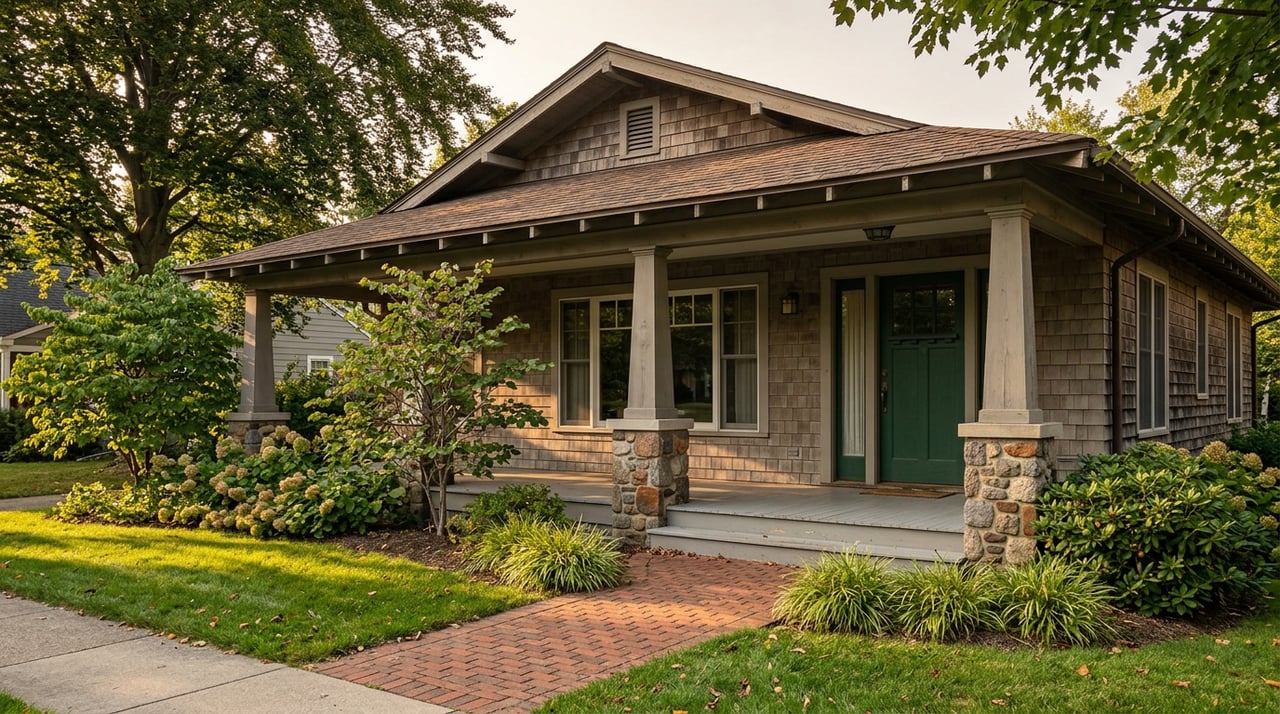
Walk a buyer through a 1920s Craftsman bungalow on one of Rosemont's curving streets and the first question is usually about the kitchen. The second question, almost always, is about the roofline: can we push out the back, add a dormer, maybe put a small unit over the garage? And that's where a lot of buyers get the answer wrong before they've even asked it, because they assume Rosemont works the way Old Town does. It doesn't.
Rosemont carries real historic weight. It was added to the National Register of Historic Places in 1992, a lushly planted 84-acre neighborhood laid out between 1908 and 1914 by a group of Washington, Alexandria, and Philadelphia investors who built it around the electric trolley line into the city. The district holds 456 contributing buildings, including 336 houses and apartment buildings, a school, a commercial building, and 118 private garages, in a mix that runs from small Craftsman bungalows to Colonial Revival houses built through 1930. That's a genuine, documented piece of Alexandria history, and it's part of what makes the neighborhood feel cohesive in a way newer subdivisions never quite manage.
None of that history comes with a design review board.
The Distinction Most House Hunters Skip Past
Alexandria has seven National Register Historic Districts: Fairlington, Old and Historic Alexandria, the George Washington Memorial Parkway corridor, Uptown/Parker-Gray, Parkfairfax, Rosemont, and the Town of Potomac. Only two of those seven are locally regulated by the city's Board of Architectural Review: Old and Historic Alexandria and Parker-Gray. The city's own preservation office draws this line explicitly. Rosemont's National Register listing is a historical designation. It is not a local regulatory district, and the BAR has no authority over what happens to a Rosemont house's exterior.
That gap matters because the BAR is not a rubber stamp. It's a seven-member board empowered to require a Certificate of Appropriateness for new construction and exterior alterations visible from a public street in the districts it does regulate, and a Permit to Demolish for any removal of more than 25 square feet of material, regardless of whether anyone can see it from the sidewalk. A denied application can't come back before the board for a year. None of that process touches a house in Rosemont.
| Old & Historic Alexandria / Parker-Gray | Rosemont | |
|---|---|---|
| Locally regulated by BAR | Yes | No |
| Certificate of Appropriateness needed for exterior changes | Yes, for anything visible from a public way | Not required |
| Permit to Demolish for removing more than 25 sq ft of material | Yes | Not required |
| Standard city building permit | Yes | Yes |
| Interior renovations | No BAR review needed either way | No BAR review needed either way |
The standard city permit process still applies everywhere in Alexandria. Rosemont homeowners aren't skipping code review, inspections, or the Department of Planning and Zoning. They're skipping the extra layer that governs how a house is allowed to look from the street.
What the Regulatory Gap Is Actually Worth
Time and money, mostly. A 2026 remodeling cost guide from Vale Construction, a general contractor active across the city, lays out what BAR review does to a project timeline: standard permitting in Alexandria runs 4 to 12 weeks, but historic district work adds another 8 to 16 weeks on top for BAR review. On a full renovation timeline that already stretches 12 to 18 months from first design meeting to final walkthrough, a two-to-four-month regulatory detour is not a rounding error. It's the difference between finishing before a school year starts and finishing after it.
The same guide puts a real number on a project type common in Rosemont's older housing stock: a 200-square-foot kitchen bump-out there runs around $125,000 all-in. Citywide, additions in Alexandria generally run $350 to $650 per square foot, a range the guide attributes to labor costs that sit 15 to 25 percent above national averages, tighter Northern Virginia contractor availability, and a housing stock old enough that surprises are the norm rather than the exception. None of that changes based on zip code. What changes is whether a homeowner also has to design around a board's aesthetic guidelines and wait months for a hearing date before the general contractor can even start pulling permits.
The Part Rosemont Buyers Still Need to Plan Around
Skipping BAR review doesn't mean skipping every complication. A separate Alexandria-area remodeling firm, NextDay Remodeling, flags a pattern specific to Rosemont and Del Ray: narrower lots in both neighborhoods often run into the city's setback limits when owners try to add a second story. A lot that looks like it has room for a full second-floor addition on paper can still hit a wall once a surveyor measures the actual buildable envelope.
The same firm notes that tying new construction into an older home's existing frame, roofline, electrical panel, and plumbing typically adds $15,000 to $25,000 to a project regardless of size, a cost driver that shows up constantly in the older housing stock of Del Ray, Rosemont, and Old Town, where original framing and wiring rarely meet current code. A Rosemont buyer who skips a pre-offer walkthrough with a contractor and assumes the absence of BAR review means an easy addition is trading one kind of surprise for another.
Accessory dwelling units are worth a specific mention here, since they've become a more realistic option across the city. Site Plan Creator notes that Alexandria has actively expanded ADU allowances as part of its broader housing strategy, and owner-occupancy requirements that used to limit who could build one have been relaxed. A Rosemont ADU still needs a standard building permit, zoning compliance review, and a site plan showing setback and lot coverage, but it does not carry the additional BAR layer that a comparable project inside Old Town or Parker-Gray would require.
Why the Timing Makes This More Than a Technicality
This regulatory gap would matter in any market. It matters more right now because of how Rosemont is trading. Across 51 closed, fee-simple single-family sales in the Del Ray and Rosemont zip code between January 1 and June 18, 2026, the typical home went under contract in a median of five days, with two-thirds under contract inside a week. The median sale price landed near $1.19 million, and the typical home sold at 100 percent of its asking price. For comparison, homes across Northern Virginia averaged 15 days to contract over that same stretch, and the national median ran to 37.
A market moving that fast rewards buyers who can act with confidence on a house that isn't perfect yet, and confidence is exactly what the BAR gap provides. A buyer looking at a Rosemont bungalow that needs a rear addition or a second-story pop-top can price the renovation with a standard 4-to-12-week permit runway in mind, not the extended, hearing-dependent timeline that governs the same project once it crosses into Old Town's locally regulated district. That difference can be the deciding factor between making a competitive offer on a house with real upside and passing on it because the renovation math felt too uncertain to pencil out in five days.
Frequently Asked Questions
Does Rosemont have any design review at all? No board reviews exterior changes to individual Rosemont properties. The National Register listing documents the district's historical significance but carries no local permitting authority. Any homeowners' association or civic association in the neighborhood may have its own informal expectations, but those aren't enforced through the city's Board of Architectural Review process.
Can I tear down a house in Rosemont and rebuild? The BAR's Permit to Demolish requirement, which applies in Old and Historic Alexandria and Parker-Gray, doesn't extend to Rosemont. A teardown there still goes through the standard city demolition and building permit process, without the additional board hearing.
Does this affect resale value? The data available doesn't isolate regulatory status as a price driver on its own. What's clear is that Rosemont's architectural cohesion, developed through a shared building era rather than an enforced review board, has held up well enough to support the fast, high-percentage-of-asking sales seen in the neighborhood through the first half of 2026.
Where This Leaves You
If you're comparing a historic-adjacent house in Rosemont to one in Old Town, the National Register plaque tells you about the past. It doesn't tell you what you're allowed to build next. Knowing the difference before you write an offer, not after, is what turns a renovation plan from a guess into a number you can actually use in negotiations.
If you're weighing a Rosemont purchase against the renovation you have in mind, Adrianna Vallario can walk the property with you, flag the setback and lot-coverage issues before they become surprises, and put together a clear picture of what the house is worth as-is versus what it could be worth after the work. Get your free Alexandria home valuation to start that conversation with real numbers instead of assumptions.
This article is general information, not legal, tax or financial advice. Consult a qualified professional about your situation.